Zhu
The Master Butchers Singing ClubThe pig in The Master Butchers Singing Club occupies the uneasy space between food, livelihood, and animal subjecthood. Most clearly in the episode of the prize sow, a routine act of butchery becomes a reversal: the animal resists the human plan, Fidelis Waldvogel is injured, and after the sow is killed he finds himself grieving for her. Across the novel’s food imagery, pigs and pork also belong to a wider world of skill, memory, and care, in which meat is not merely a commodity but the result of work and relationships.
The Pig within a Butcher’s World
Fidelis’s occupation rests on a learned belief that killing can be practiced as a precise craft. His family regards butchery as an art, mastered through years of study: a qualified master butcher must understand spices and sausage-making and know how to use a knife with exact judgment. In Fidelis’s perception, his father’s practiced hands guide an animal from its living form into orderly cuts. The pig is therefore situated within a human system that turns animal life into food, but the novel also makes that conversion morally and emotionally unsettled.
That tension has a parallel in Fidelis’s first encounter with machine-sliced bread. In Ludwigsruhe, soon after his marriage to Eva Waldvogel, he sees a white, square loaf sent from distant relatives in a coastal city. Its uniform slices suggest a new, mechanized way of making an everyday food. Fidelis’s family, by contrast, understands food-making as skilled work: his father’s sausage-making principles require the finest ingredients, including fresh garlic, clean and fresh casings, and good salt. When Fidelis later works for Pete Kozka and the trade expands, he carries these standards into his own labor. The pig’s transformation into food belongs to this ethic of craftsmanship, even as the sow’s resistance exposes the living creature that the finished products can obscure.
The Mecklenbergs’ Prize Sow
One summer morning, Fidelis is expected to slaughter a prize sow belonging to the Mecklenbergs and divide her into familiar cuts and preserved foods. The sow has spent the night in a holding pen, and her usual expectation of being fed is frustrated. The narration briefly considers the encounter from the animal’s side: she may sense that circumstances have changed, and she does not meet the butcher as a passive object. Hottentot waits nearby, eager for what remains after the humans have taken their share.
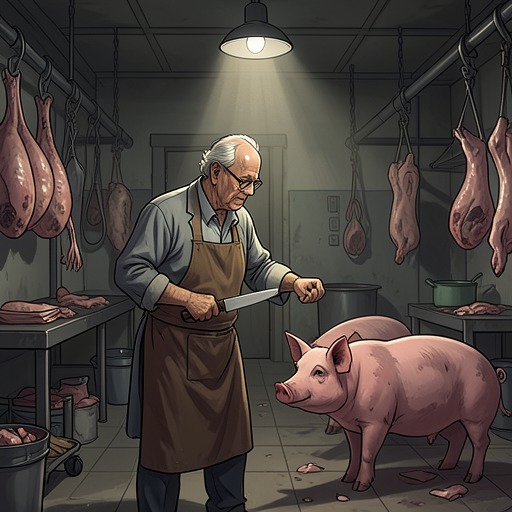
Fidelis enters the pen intending to kill the sow with his rifle, but she moves away and evades his attempts to direct her. When he slips in the muck, he has to recover before trying again. He eventually uses the movement of his apron to guide her toward a chute, where he closes the gate. The sequence makes the ordinary procedure contingent on improvisation: the butcher’s knowledge remains important, but the animal’s resistance alters the work and sets its pace.
The attempt to complete the slaughter turns against Fidelis. The sow attacks him, and Franz helps create an opportunity for his father to finish the task. Fidelis kills her and chains her to the winch to move her to the iron tub. The episode establishes a concrete reversal in their encounter: the animal marked for processing has exerted force and changed what happens to the man who came to kill her. The novel records the outcome without making the sow’s defeat erase the resistance that preceded it.
Fidelis’s Grief and the Limits of Mastery
After the sow is dead, Fidelis experiences grief that he cannot readily explain. He orders Franz away and weeps, shocked that his sorrow is for the animal. The reaction contrasts with the deaths he has encountered in war: he recalls having seen men die, including his closest friend, without breaking down in the same way. The sow’s death has made his work newly difficult to separate from the life it ends.
That response does not undo Fidelis’s role as a butcher or resolve the contradiction between humane feeling and the killing on which his profession depends. Instead, the scene holds both facts together. He has entered the pen intending to slaughter the sow, and the family’s craft gives him the expertise to turn livestock into food. Yet when the animal is dead, his grief exceeds the practical terms of the job. The sow is not only a stage in the production of meat; in this moment, she becomes the object of an individual sorrow that Fidelis cannot control.
Pork, Labor, and Food Memory
The novel’s other references to pork place the animal within a network of work and shared nourishment. Fidelis’s trade makes pork into a range of cuts and products, while the family’s insistence on good ingredients connects food quality to the care invested in making it. The emphasis on craft does not make the animal’s conversion into food disappear; it shows how thoroughly that conversion is woven into ordinary livelihood.
Later, food associated with pork carries memory as well as sustenance. While working forestry jobs, a hungry man eats baked beans flavored with molasses, mustard, and smoked pork, a combination that recalls childhood. He eats slowly, with reverence and shame, and wipes the plate with a square slice of white bread. In another meal, Fidelis and a companion share freshly baked country bread, butter, and a generous slab of smoked, cured ham, with dill pickles. Their slow, grateful eating gives the finished food a social life beyond the act of slaughter: it is prepared, served, remembered, and shared.
The pig’s significance thus extends beyond the dramatic encounter in the pen. The sow makes animal resistance impossible to overlook within a narrative centered on butchery, while the later meals show pork embedded in family memory, skilled labor, and human care. The novel neither detaches food from the animal that supplies it nor reduces every meal to the violence of its origin. It leaves the tension visible: the pig becomes nourishment, but the work of making that possible can provoke grief in the very butcher who performs it.